
Introduction
In the previous article we looked at the generalised Hadamard transform and how it has this neat effect of placing the qubit basis state label into the exponent of the coefficient (the phase) of a transformed basis state:

Now that we know how information gets placed in to the phase of a qubit, what can we do with it?
In this article we are going to look at the Phase Kickback Trick (PKT), which is a trick that utilises this ability to place information in to the phase of a qubit, but also how we can transfer phase information from one qubit to another by using controlled quantum gates (or controlled unitaries).
Origins of the PKT appear in the Quantum algorithms – revisited (1998) paper of Cleve, Ekert, Macchiavello & Mosca, although according to John Watrous, the authors credit Alain Tapp (the same author of the Brassard-Høyer-Tapp algorithm of 1997) for independently discovering the trick. David Deutsch came very close to discovering it while publishing his eponymous algorithm in 1992, but didn’t actually use it.
Binary Representations
To be able to understand the PKT we first need to get familiar with binary representations of integers.
Let’s use the integer 
We now ask: what is this in binary?
The short answer is that it is: 
The slightly longer answer is that it is a length-2 bitstring – the term “bitstring” is to say that it is a string of symbols from the alphabet of bits (i.e. 


Someone a little more familiar with binary might say that it is also a length-3 bitstring! After all, 
Then, eadem ratione it’s also the length-4 bitstring 
We can keep going and say that the integer 
So, for now, let us work with just one leading zero so that 


For each of the three symbol slots in the 3-dimensional binary representation 


But keep in mind that for a arbitrary integer 

Binary Representations
What we need now is a formula for the binary expansion given any length 

Why did we bother with the zero in that sum? Well, there is good reason and it has to do with the number of qubits we chose initially. Since we are working with 3 qubits we want 3 summands. This is because we can re-write the above sum as

This is the standard binary representation of an integer 


which generalises to any integer 

where 
We can go one step further and write this sum more compactly as

With a dimension/string-length

So we get the (

which has a solution (in the group 

Thus, according to the formula, the (

and that’s how you do it.
Why Binary Structure Matters for Phase Kickback
Since the generalised Hadamard outputs amplitudes of the form

the product 


we have that

resulting in

And since each 
The Controlled-U Gate
As mentioned briefly in the introduction, we aim to be able to transfer information from a target qubit to the phase of a control qubit. To do this we will need a controlled unitary operator.
Unitary Operators and Eigenstates
Consider a unitary operator 


One of the first things we can say about the unitary

This is the definition of an eigenstate – it must be defined with an operator and an associated eigenvalue.
The EE-problem for a unitary operator and a quantum state is to say that: applying the unitary operator 

In the language of linear algebra this is nothing but a square matrix multiplied by a column vector (ket) equalling another scaled column vector, where the amount of scaling that occurs is just the eigenvalue
The question is: can we take the phase (the eigenvalue) and somehow apply it to another qubit? Can we transfer phase information from one qubit to another?
While not immediately obvious, the answer is: Yes.
In what is to come, we need to keep in mind our assumptions:
- We have chosen a particular unitary operator
- We aim to be able to take this eigenvalue/phase and actually do something with it, namely: somehow encode the phase onto another qubit (called the target qubit).
A Little Preview
To set the scene for what is to come, observe the following neat property of a unitary
From the property of the eigenvalues we already have 


which results in a combined state

and, importanly, the state can be factored out!

The target is unchanged and the phase appears on the control qubit! Exactly as we want.
Note that we have just shown how the phase kickback works automatically with a control qubit, a target qubit (initialised in an eigenstate of some unitary), and a controlled version of that unitary. However, many quantum algorithms also use an Oracle, so in the next section we will present the phase kickback trick as being packaged together with an Oracle (even though technically it is not required).
The Phase Kickback Trick
One thing I want to mention first: the PKT is a protocol, i.e. it is a recipe, a set of instructions, a subroutine, that one must implement specifically to achieve the outcome of kicking back the phase to the control qubit. I am not aware of the PKT being perfomed naturally. In this case, the PKT is a sequence of controlled operations that must be applied in a certain way to achieve the kick-back.
Controlled Unitary Gates
We just need a few ingredients to start using the PKT.
- we need a register of
,
- we need an ancilla qubit (i.e. an extra qubit)
initialised in the zero state. The requirement that it be initialised in to the zero state is important and will become obvious, and finally,
- we need an oracle, i.e. a reversible unitary operaor
. This is a so-called oracle because we don’t care how it operates, we only care that it can distinguish particular states from others. Please read my blog here for more information on this oracle object. In short, it should act like a switch statement that reacts to various inputs.
But what does the subscript 
The subscipt actually indicates that the reversible unitary operator
We will define the oracle as

where 
If the target is, say 

which provides the phase kickback.
We have thus implemented the controlled unitary via an oracle, which makes it appear like the oracle is doing the phase kickback, but not really, it’s just part of the switch statement, per se. The main job of the oracle, however, is to encode a classical function 
A Practical Example
Let’s make some of these things concrete. Let’s pick an actual unitary, say, the controlled-

with action on the computational basis states as

thus, 

The oracle works by implementing the controlled-
- If control is
- If control is
Now allow the control qubit to be in a superposition 


If we apply the controlled gate we get this as output:

and the target state can be factored:

The target physical state is unchanged, and the phase has appeared to be multiplying the
If we make the control qubit the plus state: 

from qiskit import QuantumCircuit
from qiskit.quantum_info import Statevector
from qiskit.visualization import (
    plot_bloch_multivector,
    plot_state_qsphere,
    plot_state_city,
    array_to_latex
)
import numpy as np
import matplotlib.pyplot as plt

# --- Dark mode styling for matplotlib ---
plt.style.use('dark_background')

def show_state(state, title="Quantum State"):
    """Plot a quantum state in multiple visualisations."""
    print(title)
    display(array_to_latex(state.data, prefix="\\text{Statevector}="))

    # Bloch sphere (only works for 1 or 2 qubits per subsystem)
    try:
        display(plot_bloch_multivector(state))
    except:
        pass

    # Q-sphere (good for visualising phases)
    display(plot_state_qsphere(state))

    # Real/Imaginary parts
    display(plot_state_city(state))

def phase_kickback_circuit(phi):
    """Return a 2-qubit phase kickback circuit for rotation angle phi."""

    qc = QuantumCircuit(2)

    # Prepare control in |+>
    qc.h(0)

    # Prepare target in |1>
    qc.x(1)

    # Controlled-Rz rotation
    qc.crz(phi, 0, 1)

    return qc

phi = np.pi / 3   # try a 60 degree phase
qc = phase_kickback_circuit(phi)

qc.draw('mpl')  # dark-style Matplotlib circuit

# Initial state before CRz
qc_init = QuantumCircuit(2)
qc_init.h(0)  # control |+>
qc_init.x(1)  # target |1>

state_before = Statevector.from_instruction(qc_init)
state_after  = Statevector.from_instruction(qc)

print("State BEFORE kickback:")
show_state(state_before, "Before Kickback")

print("\nState AFTER kickback:")
show_state(state_after, "After Kickback")
The state before the kickback:
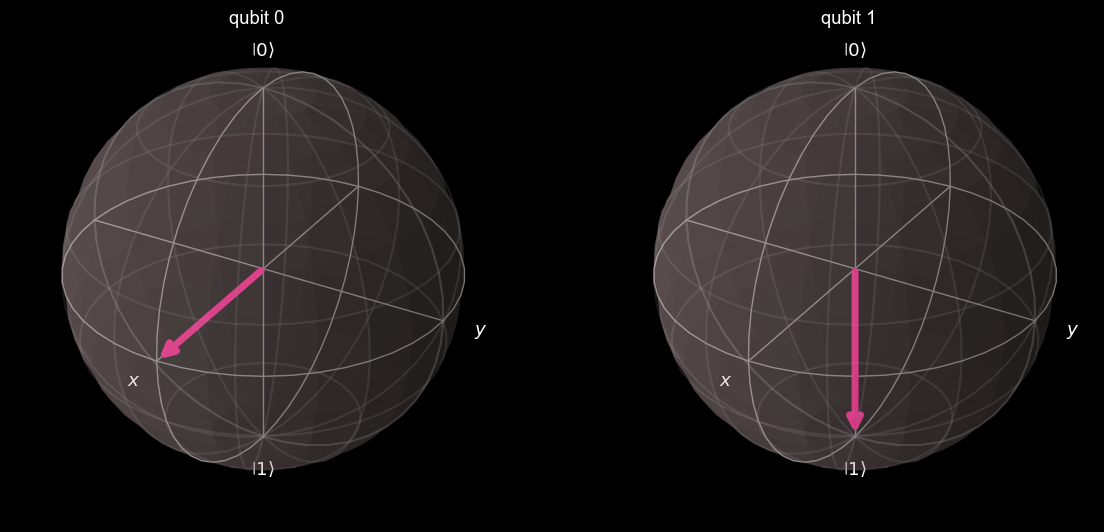
and the state after the kickback:
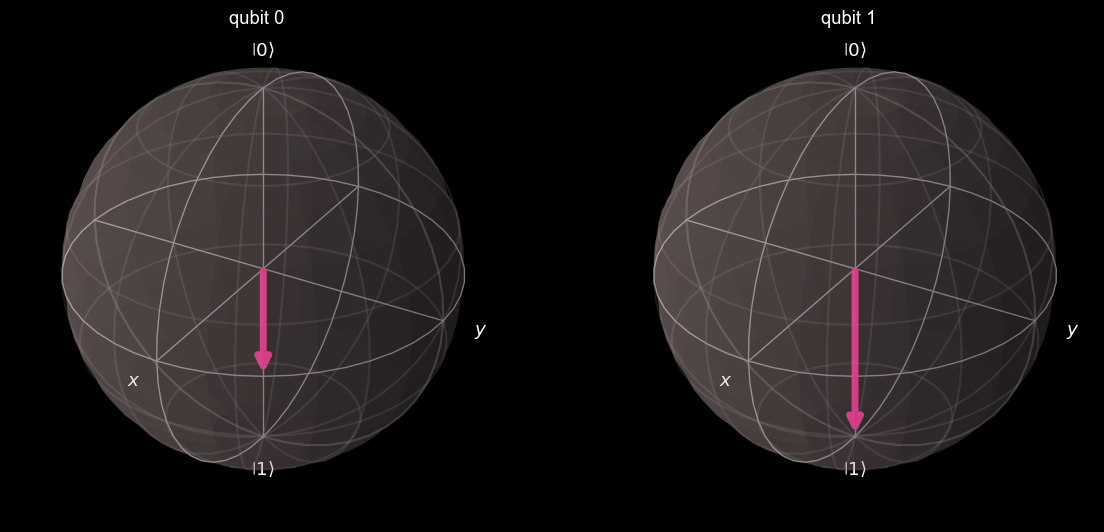
The control qubit (qubit 0) had its Bloch vector rotated around the 

The phase kickback trick works if the target qubit is an eigenstate of the controlled unitary, then the control qubit picks up a phase.
In fact, if the target qubit was not an eigenstate of the controlled unitary, then the controlled unitary would entangle both control and target qubit, and you would not achieve a clean phase kickback.
Conclusion
It turns out that many quantum algorithms boil down to somehow encoding the answer you’re looking for in to the phase of ancilla qubits (with the help of controlled-unitary gates). The generalised Hadamard maps 


Thus, all the information about how many times (also the basis label) you applied the shift unitary 
References
[1] https://medium.com/quantum-untangled/a-clever-quantum-trick-54f27e2518a4
[2] https://nosarthur.github.io/quantum%20information%20and%20computation/2018/01/26/kickback.html
[3] Quantum Phase Estimation – Qiskit Textbook
[4] Quantum Algorithms Revisited – Cleve, Ekert, Macchiavello & Mosca (1998).+
 From First Principles